XM ACCENT · TECHNICAL KNOW-HOW
Understanding Curtain Hardware Load Capacity
A practical guide to specifying rods, tracks, and brackets correctly the first time
Every curtain rod, track, or bracket has a limit. Most of the time buyers never think about it — until a rod bows in the middle of a window, or a bracket pulls out of the wall six months after installation. Load capacity isn’t an exotic engineering topic; it’s a handful of practical ideas that any product manager, buyer, or installer can use to specify hardware correctly the first time.
What “load capacity” actually means
When fabric hangs on a rod or track, the hardware acts as a beam supported at each bracket. That beam has to resist two different things:
- Bending failure — the material itself yielding or cracking under stress. This is the catastrophic failure mode, and it’s rare in normal residential use.
- Deflection (sag) — the rod bowing visibly between brackets. This is the failure mode that actually generates complaints. A rod can be nowhere near its structural limit and still look unacceptable if it sags a few millimeters over a long span.
In almost every real-world case, sag shows up long before structural failure does. That’s the single most useful thing to know: load capacity charts in the curtain hardware industry are usually governed by appearance, not strength.
load-capacity
The three variables that determine capacity
1. Material and cross-section
Solid rods are stiffer than tubes of the same diameter, but tubes give more stiffness per unit of weight and cost. Steel and iron are stiffer than aluminum for a given shape; aluminum is lighter and corrosion-resistant but needs a larger cross-section to match steel’s rigidity. Wood sits at the bottom for stiffness relative to size, which is why wood poles are usually sold in larger diameters.
2. Bracket spacing
This is the variable with the most leverage. Capacity drops with roughly the cube of the span for deflection, and the square of the span for bending stress — so doubling the distance between brackets can cut usable capacity by 75–90%, not 50%. A hardware line that looks “heavy duty” on paper can underperform badly if a customer installs brackets too far apart.
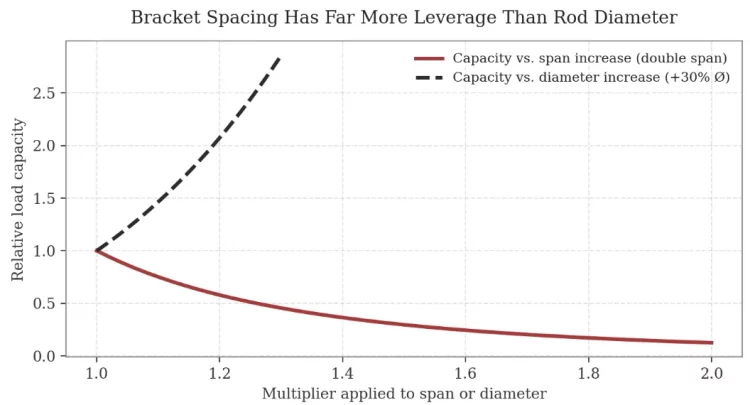
Doubling bracket span cuts capacity far more than a modest increase in rod diameter gains back.
3. Fabric weight
Often underestimated. A gathered curtain isn’t just the flat fabric weight — fullness ratio (typically 2×–2.5× the track width), interlining, and any integrated blackout backing all add up. A heavy interlined blackout panel can weigh 3–5× what a sheer of the same width weighs.
Rule-of-thumb capacity ranges
These are general guidelines across common hardware categories — actual capacity always depends on the specific profile, wall thickness, and bracket spacing used.
|
Hardware type |
Typical bracket spacing |
General load range |
Best suited for |
|
Light aluminum track |
400–600 mm |
Light to medium fabric |
Sheers, residential drapery |
|
Standard steel track |
600–900 mm |
Medium to heavy fabric |
Mixed-weight drapery, hotel rooms |
|
Motorized track (steel/reinforced alu) |
500–700 mm |
Medium to heavy, cyclic load |
Automated residential & commercial |
|
Decorative rod, 16–19 mm |
900–1200 mm |
Light to medium |
Cafe curtains, sheers, short spans |
|
Decorative rod, 25–32 mm |
1200–1500 mm |
Medium to heavy |
Standard drapery, statement rods |
|
Wood pole, 28–35 mm |
900–1200 mm |
Light to medium |
Residential, decorative-first applications |
Fabric weight cheat sheet
Use this to translate “what’s hanging” into a rough load-per-meter figure, already accounting for typical gathering fullness:
|
Fabric class |
Loaded weight (kg per meter of rod) |
|
Sheer / voile |
0.3 – 0.5 |
|
Medium-weight (cotton, linen blend) |
0.8 – 1.2 |
|
Heavy / blackout |
1.5 – 2.5 |
|
Heavy blackout + interlining (contract grade) |
2.5 – 3.5 |
Why bracket spacing quietly matters more than rod diameter
A common mistake in spec sheets is presenting rod diameter as the main lever for load capacity, when in practice bracket spacing usually dominates the outcome. Two installations with the identical rod can perform very differently:
- A 25 mm rod at 900 mm bracket spacing comfortably handles heavy interlined drapery.
- The same 25 mm rod at 1800 mm spacing (double the distance) can lose the large majority of that capacity to visible sag — even though the rod itself hasn’t changed.
This is why professional installation guides always specify a maximum bracket spacing for a given rod/track and fabric class, rather than a single load number in isolation. A load rating without a stated span is close to meaningless.
Where hardware actually fails in the field
In practice, failures rarely trace back to the rod or track itself:
- Bracket-to-wall fixing — screws into drywall or plaster without anchors into a stud/masonry are the single most common failure point, independent of how strong the rod is.
- Thin-wall extrusions — a track that looks identical to a heavier-duty version but uses thinner wall aluminum to save cost will sag well before its rated span, especially under motorization’s added cyclic stress.
- Undersized end brackets on wide spans — the last bracket on each end carries an asymmetric load once curtains are drawn to one side; underspeccing end supports is a common oversight.
- Ignoring motorized duty cycle — motorized systems add friction and start/stop acceleration loads on top of static fabric weight, which static load charts don’t capture.
A simple specification checklist
- Identify fabric class (sheer / medium / heavy / heavy + interlining) and estimate kg/m.
- Choose hardware rated for that load at the bracket spacing you actually intend to use — not the maximum span in a datasheet.
- For spans over ~1.5 m, plan for an intermediate bracket rather than relying on end supports alone.
- Confirm the fixing point (stud, masonry, reinforced drywall) matches the pull-out rating of the bracket hardware, not just the beam capacity of the rod.
- For motorized tracks, apply a margin of roughly 20–25% over the static rating to account for dynamic load and long-term fastener fatigue.
This guide covers general principles for specifying curtain hardware. Actual load capacity depends on the specific material, wall thickness, and finish of a given product line — always verify against manufacturer test data for contract and commercial projects.