For years, curtain hardware was an afterthought — a plain rod, a couple of brackets, done. Not anymore. As window aesthetics shift away from purely functional “sticks” toward sculptural, high-tech, statement-making hardware, homeowners are realizing that a generic rod can undercut an otherwise high-end room, while the right hardware can make even affordable drapes look expensive. If curtains are the outfit, hardware is the jewelry — and in 2026, the jewelry has a very specific look.
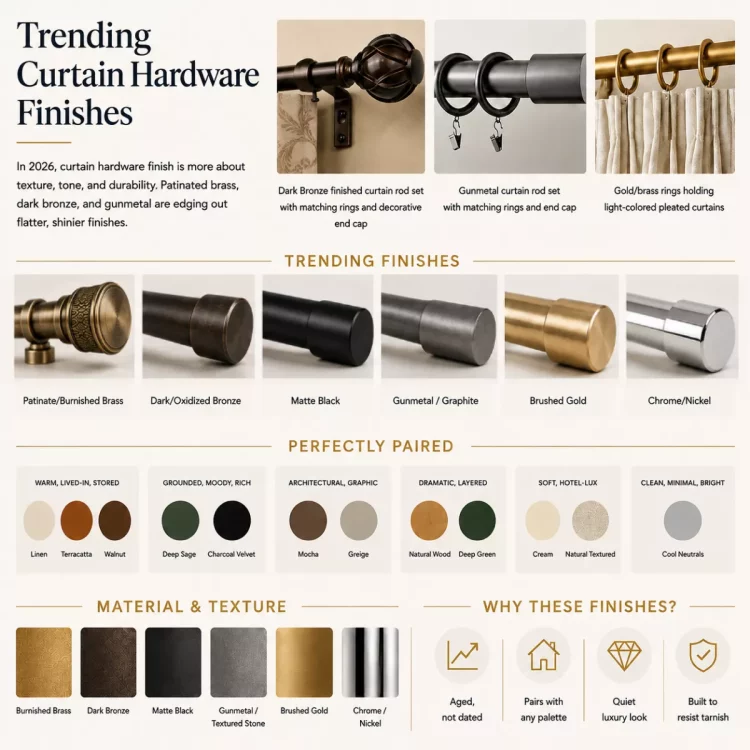
mood board of 2026’s trending curtain hardware finishes.
Quick-Reference: Finish Personality Guide
|
Finish |
Mood |
Best Paired With |
Watch-out |
|
Patinated / Burnished Brass |
Warm, lived-in, storied |
Linen, terracotta, walnut |
Can look dated if over-polished |
|
Dark / Oxidized Bronze |
Grounded, moody, rich |
Deep sage, charcoal velvet |
Needs strong ambient light |
|
Matte Black |
Architectural, graphic |
Mocha, greige, white walls |
Can feel cold in small rooms |
|
Gunmetal / Graphite |
Dramatic, dimensional, layered |
White walls, natural wood, deep greens |
Can look identical to matte black in poor lighting |
|
Brushed Gold |
Soft, hotel-luxe |
Cream, natural texture |
Avoid pairing with polished brass |
|
Chrome / Nickel |
Clean, minimal, bright |
Cool neutrals, modern spaces |
Least warm option in the lineup |
Fig. 1 — A field guide to pairing 2026’s leading finishes with fabric, palette, and room mood.
1. Patina Is Replacing Polish
The matte black moment isn’t over, but it’s no longer the only story. Hardware trends are moving away from the ubiquitous matte black and shiny finishes toward richer, more nuanced options. Designers point to a decisive shift toward dark and patinated finishes — burnished brass, dark bronze, and naturally oxidized metals that develop character over time — the opposite of a finish meant to look flawless on day one.
This tracks with a broader design mood: pieces that age well rather than pieces that are simply low-maintenance. There’s a growing interest in quality hardware that lasts and ages beautifully, mirroring how investment furniture is replacing fast-fashion pieces.
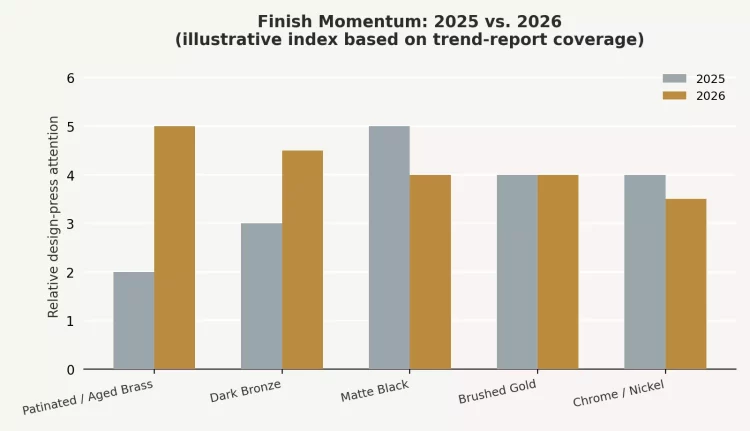
Fig. 2 — Illustrative momentum index comparing design-press attention on each finish, 2025 vs. 2026.
2. Warm Metals Still Lead, But Brushed, Not Shiny
Brass hasn’t gone anywhere — it’s just gotten quieter. Matte black, brushed gold, and chrome remain the anchor finishes carrying into 2026, and brushed gold in particular has a soft, muted glow that reads luxurious without being overpowering, pairing well with warm neutrals and natural textures. Chrome and polished nickel are holding steady for their clean, reflective, minimalist feel — especially in bathrooms and transitional spaces.
The throughline across every finish: nothing shouts. This is the hardware version of “quiet luxury.”
3. Gunmetal Is Becoming the New Matte Black
Matte black hasn’t disappeared, but it’s sharing the stage with a moodier, more dimensional cousin: gunmetal. Where flat black absorbs light entirely, gunmetal and graphite finishes carry a subtle metallic undertone that catches light at the edges, giving hardware more depth without tipping into shine. Designers describe it as offering the same dramatic weight as matte black, but with a richer, more layered character — striking against light cabinetry and walls, and warmer against natural wood tones than a true flat black ever reads.
This is a finish story about tone and undertone, not just color: two dark metals that look similar in a product photo can behave completely differently once they’re catching real window light.
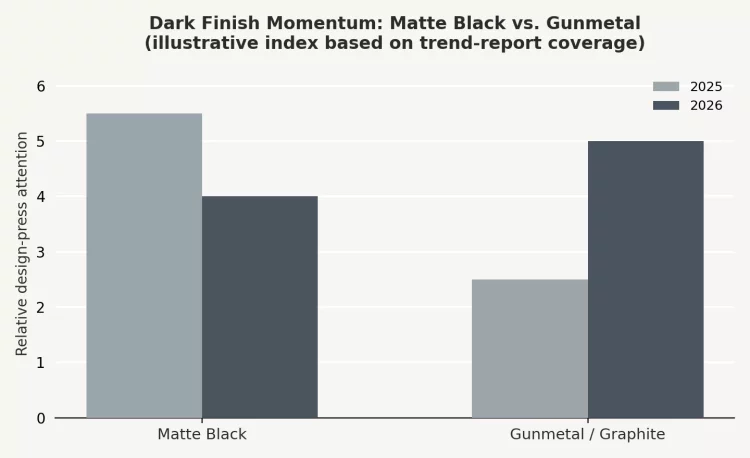
Fig. 3 — Illustrative shift in design-press attention from matte black toward gunmetal and graphite tones.
4. Mixing Metals Is In — With a Limit
Layering finishes has become an accepted move rather than a design faux pas, but it comes with a rule of thumb worth borrowing: hold a single room to about two distinct metal finishes. Two reads as collected. Four reads as an accident.
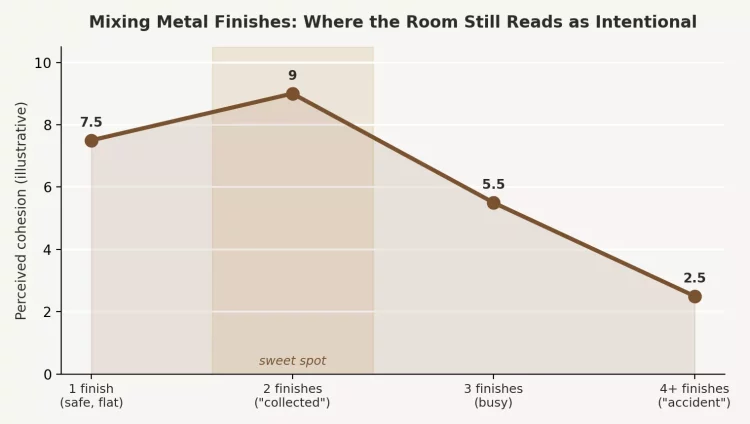
Fig. 4 — Illustrative relationship between the number of metal finishes in a room and how cohesive it reads.
5. Durability Finishes: PVD Coating Changes the Maintenance Conversation
The biggest technical shift in finish this year isn’t a color — it’s how the color is applied. Physical Vapor Deposition (PVD) coating, long used in door and plumbing hardware, is showing up more in curtain hardware as buyers get tired of finishes that fade. Unlike a sprayed lacquer that sits on top of the metal, PVD bonds at a near-atomic level, which is why it resists scratching, fingerprints, UV fading, and salty coastal air far better than traditional plating or an unsealed, unlacquered metal that’s left to tarnish naturally.
The trade-off is intentional: PVD-coated hardware won’t develop the soft living patina described in Trend 1 — it’s built to look the same on year five as it did on day one. That makes it the practical counterpart to the aged-metal movement rather than a competitor to it: designers are increasingly choosing patina where they want a finish to age, and PVD where they want it to stand still, especially in bathrooms, sunrooms, and coastal homes where humidity and salt air are hardest on hardware.
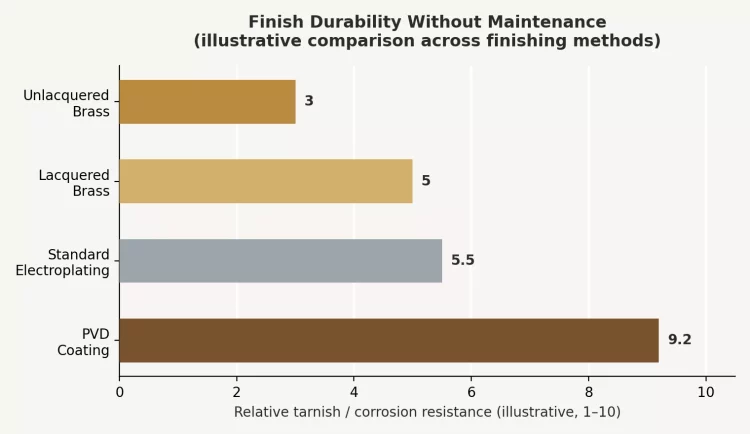
Fig. 5 — Illustrative durability comparison across common finishing methods, based on published corrosion-resistance behavior of each process.
The Takeaway
2026 hardware finishes are less about chasing a single “it” color and more about restraint with texture and intent behind durability: warm over cold, aged over shiny, gunmetal over flat black, and — increasingly — a deliberate choice between letting a finish age naturally or specifying a coating that won’t age at all. The common denominator is that finish is finally being treated as a technical decision, not just a color swatch.
For anyone sourcing or designing with curtain hardware this year, the safest bet isn’t picking a trend — it’s picking a finish that will still look considered five years from now.
What finish are you seeing pop up most in client projects right now — patinated brass, matte black, or something else entirely? Curious to hear what’s showing up on your mood boards.